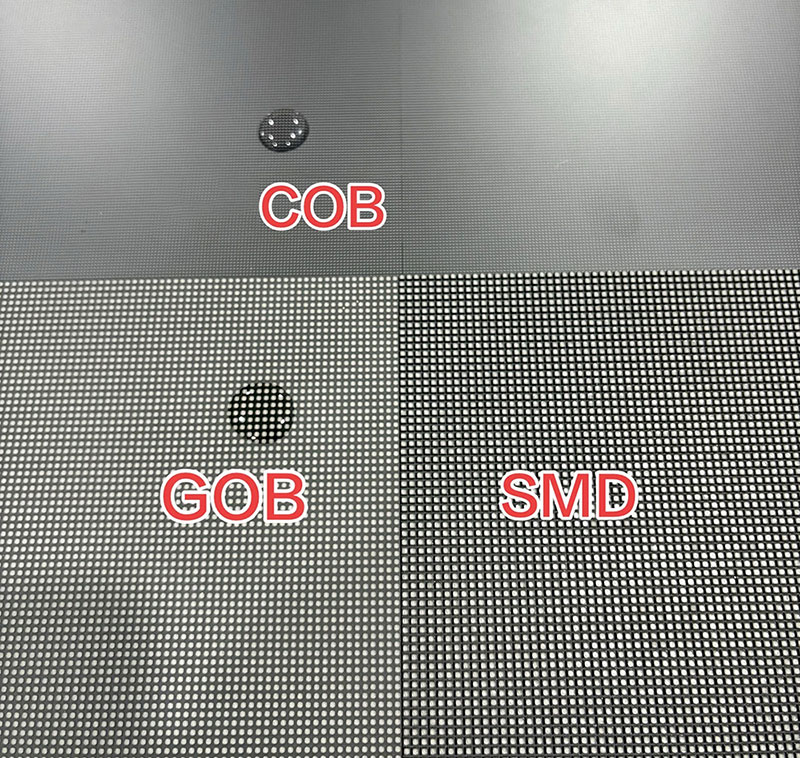
The COB and GOB are more and more popular on LED industry, so what are the differences? Here is a brief explanation of the differences, advantages, and disadvantages of SMD, GOB, and COB LED packaging technologies:
COB GOB SMD
SMD (Surface-Mount Device)
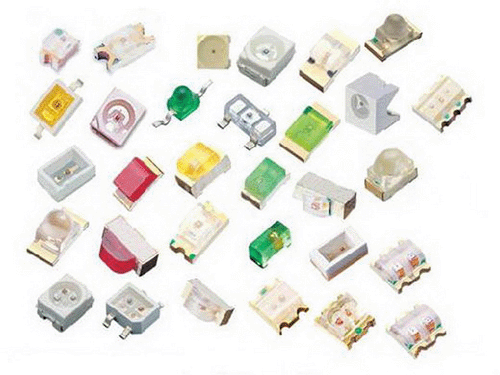
Core Concept: Individual RGB LED chips are pre-packaged into separate lamp beads with plastic brackets, and then soldered onto the PCB.
Advantages:
Low Cost: Mature mass-production technology with a wide supply chain.
Repairable: Single faulty pixels can be replaced individually.
High Brightness: Well-suited for outdoor applications.
Disadvantages:
Vulnerable: Protruding lamp beads are susceptible to damage from impact, dust, and moisture.
Visible Pixilation: Noticeable “screen-door effect” when viewed up close.
Limited Miniaturization: Difficult to achieve ultra-fine pixel pitches below P1.0.
GOB (Glue On Board)
Core Concept: A protective upgrade for SMD, where a layer of transparent optical glue covers the entire surface of the SMD module, encapsulating the lamp beads and solder points.
Advantages:
Excellent Protection: Highly resistant to impact, dust, water, and scratches.
Cost-Effective Upgrade: Leverages existing SMD production lines, making it more affordable than COB.
Suitable for Public/High-Traffic Areas: Ideal for rental events or interactive displays.
Disadvantages:
Brightness Attenuation: The glue layer can cause a 10-15% reduction in brightness.
Repair Complexity: More difficult to repair than bare SMD (glue must be removed first).
Still Limited by SMD Size: Cannot achieve pitches finer than the original SMD design.
COB (Chip On Board)
Core Concept: Bare RGB LED chips are directly bonded onto the PCB without individual plastic packages, then covered with a single piece of encapsulation glue, forming a continuous surface light source.
Advantages:
Ultra-Fine Pitch: Enables pixel pitches as small as P0.4-P0.7 for high-resolution close-up viewing.
Superior Image Quality: No pixilation, high contrast, and wide viewing angles due to the surface light source.
Excellent Heat Dissipation & Durability: Direct chip-to-board contact improves heat transfer, and the fully sealed surface offers exceptional protection.
Disadvantages:
High Cost: More expensive manufacturing process.
Non-Repairable Pixels: A single faulty pixel typically requires replacing the entire module.
Strict Calibration: Color consistency is highly dependent on precise manufacturing processes.
| Item | SMD | GOB | COB | MIP |
| Core mechanism | Independent packaged lamp beads soldered to PCB | SMD + full‑surface protective glue | Bare chips directly bonded & monolithic encapsulated | Pre‑packaged micro‑chips then SMT mounted |
| Pixel pitch | ≥P1.0 | P1.0‑P2.5 | P0.4‑P1.5 | P0.3‑P0.9 |
| Repairability | Single‑pixel replaceable | Partial module repair (remove glue) | Replace whole module | Component‑/module‑level repair |
| Protection level | Low | High | Very high | High |
| Heat dissipation | Medium | Medium‑low | Excellent | Good |
| Contrast | Medium | Medium‑high | High | Very high |
| Relative cost | Low | Medium | High | High‑medium |