


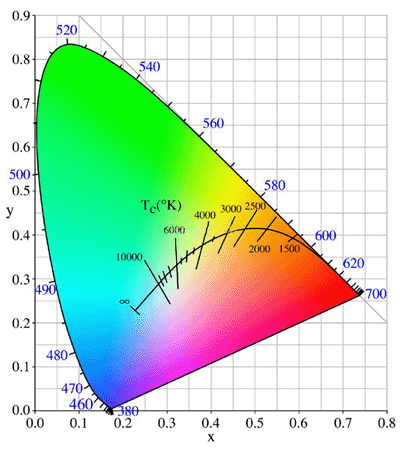
Color temperature is a characteristic of visible light that has important applications in lighting, photography, videography, publishing, and other fields. The color temperature of a light sources is determined by comparing its chromaticity with that of an ideal black-body radiator. The temperature, usually measured in kelvins(K) at which the heated black-body radiator matches the color of the light source is that source’s color temperature, for a black body source, it is directly related to Planck’s law and Wien’s displacement law.
Color Temperature
Counterintuitively, higher color temperatures (5000K or more) are “cold”(green-blue) colors, and lower color temperatures(2700-3500K) “warm”(yellow-red) colors.
Categorizing different lighting
|
Temperature
|
Source
|
|
1700K
|
Match flame
|
|
1850K
|
Candle flame
|
|
2700–3300K
|
Incandescent light bulb
|
|
3350K
|
Studio “CP” light
|
|
3400K
|
Studio lamps, photofloods, etc.
|
|
4100K
|
Moonlight, xenon arc lamp
|
|
5000K
|
Horizon daylight
|
|
5500–6000K
|
Typical daylight, electronic flash
|
|
6500K
|
Daylight, overcast
|
|
9300K
|
CRT screen
|
|
Note:
These temperatures are merely approximations; considerable variation may be present. |
|